In an ambitious and relatively short book (290 pages) titled, "The Financing of Intangible Assets: TMT Finance and Emerging Technologies" (LexisNexis), editor and author Charles Kerrigan of CMS law provides a treatment of financing of intangible assets in the technology, media and telecom sectors. The book has wide breadth and selective depth in its coverage of the subject matter. Moreover, it is a practical book which discusses mitigating risk and anticipating potential issues, including focusing on potential problems that may arise with new and emerging technology. The book first opens with five chapters that provide an overview of various relevant agreements and the role of players in the field. The second part covers security and regulation, such as “Taking Security over Intellectual Property Rights,” and “Restrictions on Assignment, Floating Charges.” The next ten chapters cover financing in various industries, including Software, Telecoms, Gambling, Music, Biotech and Healthtech, Publishing, Advertising and Adtech, Technology, TV Broadcast Media and Media Technology, and Film. The next ten chapters ambitiously highlight specific countries’ law concerning the subject matter, which are each authored by practitioners from those respective countries, or Mr. Kerrigan in collaboration with law firms in the geographic area. Finally, the book ends with ten chapters generally dedicated to an area of new technology involving finance, such as Digital Money, Blockchain and Artificial Intelligence. This book is helpful as a resource for those who desire an overview of the field and those who need a relatively detailed treatment of a specific area. It is a welcome addition to the resources concerning the topic.
Showing posts with label intangibles. Show all posts
Showing posts with label intangibles. Show all posts
Friday, 24 January 2020
Kerrigan on The Financing of Intangible Assets
In an ambitious and relatively short book (290 pages) titled, "The Financing of Intangible Assets: TMT Finance and Emerging Technologies" (LexisNexis), editor and author Charles Kerrigan of CMS law provides a treatment of financing of intangible assets in the technology, media and telecom sectors. The book has wide breadth and selective depth in its coverage of the subject matter. Moreover, it is a practical book which discusses mitigating risk and anticipating potential issues, including focusing on potential problems that may arise with new and emerging technology. The book first opens with five chapters that provide an overview of various relevant agreements and the role of players in the field. The second part covers security and regulation, such as “Taking Security over Intellectual Property Rights,” and “Restrictions on Assignment, Floating Charges.” The next ten chapters cover financing in various industries, including Software, Telecoms, Gambling, Music, Biotech and Healthtech, Publishing, Advertising and Adtech, Technology, TV Broadcast Media and Media Technology, and Film. The next ten chapters ambitiously highlight specific countries’ law concerning the subject matter, which are each authored by practitioners from those respective countries, or Mr. Kerrigan in collaboration with law firms in the geographic area. Finally, the book ends with ten chapters generally dedicated to an area of new technology involving finance, such as Digital Money, Blockchain and Artificial Intelligence. This book is helpful as a resource for those who desire an overview of the field and those who need a relatively detailed treatment of a specific area. It is a welcome addition to the resources concerning the topic.


Friday, 11 October 2019
A Greater Appreciation for the Contribution and Value of Some Intangibles (particularly "free" intangibles)?
In a recent speech titled, “Trucks and Terabytes:
Integrating the 'Old' and 'New' Economies,” at the 61st Annual Meeting of the
National Association for Business Economics, Federal Reserve Chairman Jerome H.
Powell challenged the underlying data concerning measurements of economic
growth. He asks: “with terabytes of data
increasingly competing with truckloads of goods in economic importance, what
are the best ways to measure output and productivity? Put more provocatively,
might the recent productivity slowdown be an artifact of antiquated
measurement?” In considering the question,
here are his comments:
How Should We Measure Output and Productivity?
Let's now turn to the second question of how to best measure output and productivity. While there are some subtleties in measuring oil output, we know how to count barrels of oil. Measuring the overall level of goods and services produced in the economy is fundamentally messier, because it requires adding apples and oranges—and automobiles and myriad other goods and services. The hard-working statisticians creating the official statistics regularly adapt the data sources and methods so that, insofar as possible, the measured data provide accurate indicators of the state of the economy. Periods of rapid change present particular challenges, and it can take time for the measurement system to adapt to fully and accurately reflect the changes in the economy.
Let's now turn to the second question of how to best measure output and productivity. While there are some subtleties in measuring oil output, we know how to count barrels of oil. Measuring the overall level of goods and services produced in the economy is fundamentally messier, because it requires adding apples and oranges—and automobiles and myriad other goods and services. The hard-working statisticians creating the official statistics regularly adapt the data sources and methods so that, insofar as possible, the measured data provide accurate indicators of the state of the economy. Periods of rapid change present particular challenges, and it can take time for the measurement system to adapt to fully and accurately reflect the changes in the economy.
The advance of technology has long presented measurement
challenges. In 1987, Nobel Prize–winning economist Robert Solow quipped that
"you can see the computer age everywhere but in the productivity
statistics."6 In the second half of the
1990s, this measurement puzzle was at the heart of monetary policymaking.7 Chairman Alan Greenspan
famously argued that the United States was experiencing the dawn of a new
economy, and that potential and actual output were likely understated in
official statistics. Where others saw capacity constraints and incipient
inflation, Greenspan saw a productivity boom that would leave room for very low
unemployment without inflation pressures. In light of the uncertainty it faced,
the Federal Open Market Committee (FOMC) judged that the appropriate risk‑management
approach called for refraining from interest rate increases unless and until
there were clearer signs of rising inflation. Under this policy, unemployment
fell near record lows without rising inflation, and later revisions to GDP
measurement showed appreciably faster productivity growth.8
This episode illustrates a key challenge to making
data-dependent policy in real time: Good decisions require good data, but the
data in hand are seldom as good as we would like. Sound decisionmaking
therefore requires the application of good judgment and a healthy dose of risk
management.
Productivity is again presenting a puzzle. Official
statistics currently show productivity growth slowing significantly in recent
years, with the growth in output per hour worked falling from more than 3
percent a year from 1995 to 2003 to less than half that pace since then.9 Analysts are actively
debating three alternative explanations for this apparent slowdown: First, the
slowdown may be real and may persist indefinitely as productivity growth
returns to more‑normal levels after a brief golden age.10 Second, the slowdown may
instead be a pause of the sort that often accompanies fundamental technological
change, so that productivity gains from recent technology advances will appear
over time as society adjusts.11 Third, the slowdown may
be overstated, perhaps greatly, because of measurement issues akin to those at
work in the 1990s.12 At this point, we cannot
know which of these views may gain widespread acceptance, and monetary policy
will play no significant role in how this puzzle is resolved. As in the late
1990s, however, we are carefully assessing the implications of possibly
mismeasured productivity gains. Moreover, productivity growth seems to have
moved up over the past year after a long period at very low levels; we do not
know whether that welcome trend will be sustained.
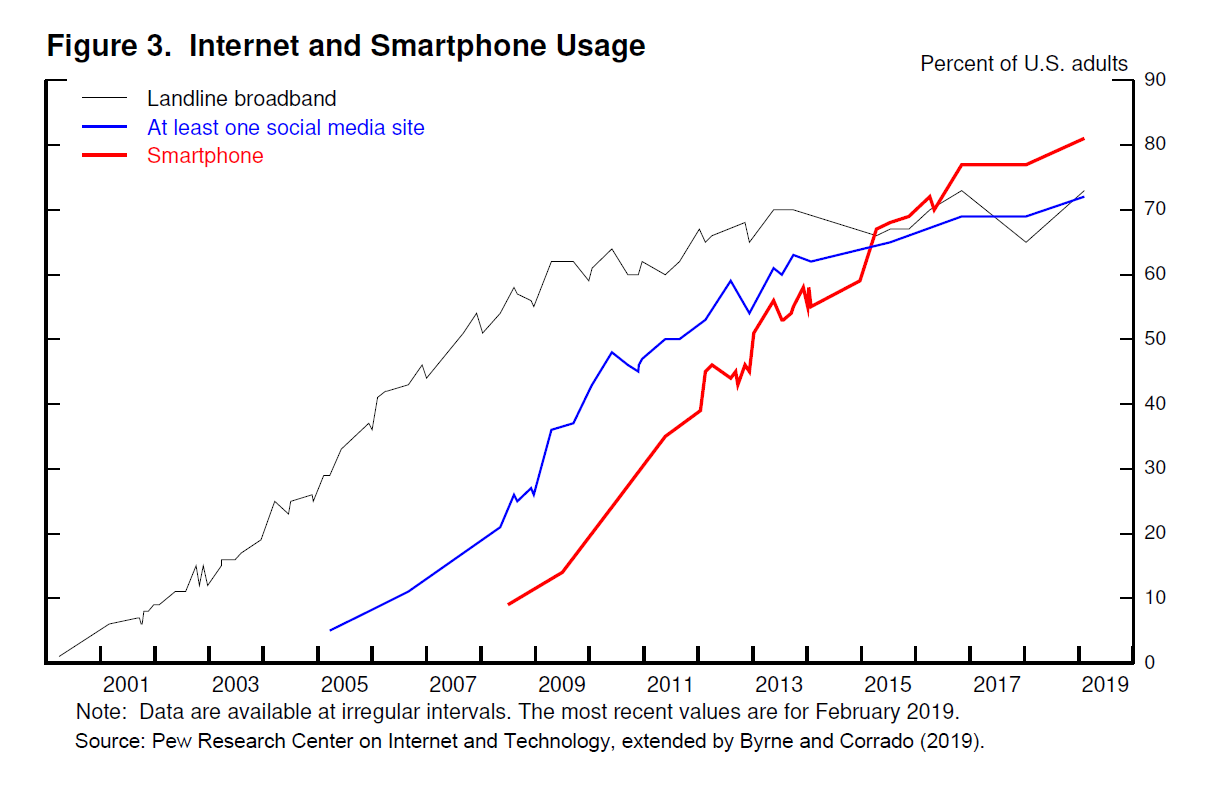
Recent research suggests that current official statistics may
understate productivity growth by missing a significant part of the growing
value we derive from fast internet connections and smartphones. These
technologies, which were just emerging 15 years ago, are now ubiquitous (figure
3). We can now be constantly connected to the accumulated knowledge of
humankind and receive near instantaneous updates on the lives of friends far
and wide. And, adding to the measurement challenge, many of these services are
free, which is to say, not explicitly priced. How should we value the luxury of
never needing to ask for directions? Or the peace and tranquility afforded by
speedy resolution of those contentious arguments over the trivia of the moment?
Researchers have tried to answer these questions in various
ways.13 For example, Fed
researchers have recently proposed a novel approach to measuring the value of
services consumers derive from cellphones and other devices based on the volume
of data flowing over those connections.14 Taking their accounting
at face value, GDP growth would have been about 1/2 percentage point higher
since 2007, which is an appreciable change and would be very good news. Growth
over the previous couple of decades would also have been about 1/4 percentage
point higher as well, implying that measurement issues of this sort likely
account for only part of the productivity slowdown in current statistics.
Research in this area is at an early stage, but this example illustrates the
depth of analysis supporting our data-dependent decisionmaking.
The full speech is available, here. The paper concerning measuring value using volume of data, titled, "Accounting for Innovations in Consumer Digital Services: IT Still Matters," is available, here.
Subscribe to:
Posts (Atom)