Showing posts with label Patents and standards. Show all posts

Monday, 26 March 2018

Where is 5G communications technology IP coming from?

As I explained in IP Finance last week, following President Trump's blocking of Broadcom’s hostile bid to acquire Qualcomm, by remaining independent the cellular technology leader will be able to maintain its long-term commitment to high levels of R&D investment (at 23 percent of sales recently), most significantly including that in 5G communications standard-essential IP.

Use Cases for 5G International Mobile Telecommunications
5G is strategically important to the entire mobile ecosystem and to many nations for economic as well as for national security reasons.  The 5G standard will support many complementary technologies and market developments. Total estimated value is $12.3 trillion in 2035.

5G is a new standard that significantly embodies cumulative technology developments from previous cellular standards including 3G UMTS and 4G LTE. Many more innovative new technologies will also be added to 5G over the next decade or so. 

Transformation and growth with 5G
Mobile communications has improved in leaps and bounds since the introduction of analog phones in the early 1980s. After cellular was only significantly used for voice calling for a couple of decades, network traffic from voice was surpassed by data communications in 2009 with demand for the latter at least doubling every 18 months ever since. This is no mean feat. It resulted from major investments in technology R&D as well as in network facilities and new devices.

Exponential growth in mobile data
With the first commercial 5G deployments from around 2019, the new standard promises to be transformative and facilitate further growth with:
  • Enhanced mobile broadband—even more of the above, with higher speeds and increased capacity to support that and additional users
  • Ultra-reliable and low-latency communications for applications such as self-driving cars
  • Massive Machine Type Communication in the Internet of Things (IoT) to connect tens of billions of sensors and other devices worldwide
While market opportunities are wide ranging and will include numerous technologies, they are most significantly underpinned by the mobile communications technologies developed and contributed to the 5G standard, including IP protected by standard-essential patents.

Building on the shoulders of giants
5G is substantially based upon previous cellular technologies. For example, whereas previous advances from 1G to 2G, from 2G to 3G and from 3G to 4G where largely defined by a totally new “air interface”, both 4G LTE and 5G “New Radio” are predominantly based on OFDMA wireless technology. 5G is also capitalizing on many other technologies that were already introduced in previous standards. Examples include QAM modulation, MIMO space division multiplexing and multi-carrier aggregation technologies. This short paper of mine explains in greater depth how seminal and foundational technologies are initially contributed to the standards and are then also very valuably reused in later standards. As standardization progresses, many more companies get involved in the process, including some who supplement these foundational technologies with additional contributions of varied worth.

As declarations begin to be made—of patents that owners believe are essential to the 5G standard—it will soon become apparent that a clear majority of these will have already have been declared essential to previous standards including various 3G standards and 4G LTE. Technology-IP leaders in 3G and 4G will therefore also tend be the leaders in 5G.

It is still very early for 5G SEP declarations because declarations are usually made several months after the setting of standards. The first standardization of 5G was not until December 2017 in 3GPP Release 15.[1]

Following this initial 5G standard release, there is substantial additional and ongoing development work including trials, debugging, development of commercial products and the introduction many new technical features and performance improvements.

Leading cellular technology innovators, among others, will continue to make new contributions to the standards in 5G, including additional technologies that are being introduced in later releases of the 5G standard, as also illustrated in this Qualcomm blog posting.

Quality trumps quantity in SEPs
The value of standard-essential technologies is largely a function of patent quality—particularly including seminal and foundational contributions—rather than of the raw numbers of patents filed, issued or declared essential to the standards. Nevertheless, significant attention is paid to these metrics, and on the numbers of technical contributions to standard setting organizations because these figures are easy to count and promote in the media, in licensing negotiations and in court litigation.

However, SEP declarations and the number of technical contributions companies make to the standard-setting process can easily be inflated by those who seek to “game the system.” Declarations of patents that owners believe might be essential or might become essential to the standards are not policed or verified by SSOs. Their IPR databases were set up to identify patents and their owners, not for the purposes of apportioning SEP value or FRAND royalty rates. As I have indicated previously in IP Finance, patent counting is inaccurate and unreliable even when third parties make essentiality checks.


[1] 3GPP is the stand setting organization responsible for all the major mobile communications standards including 2G GSM, 3G UMTS, 4G LTE and 5G.

Tuesday, 24 November 2015

Vote on FRAND?

World Intellectual Property Review is running a survey about FRAND and the formation of the Fair Standards Alliance reported on this blog here.

WIPR is asking whether you agree that the definition of FRAND must have a clearer meaning to allow standards to foster innovation. There's no link provided to the arguments set out in the Fair Standards Alliance's white paper (found here), but at least one can post comments.

In this blogger's view, the question is a leading one. It's seems to be a no-brainer that it would be nice to have a clearer understanding of FRAND. But what does a clearer understanding mean? Clearly different things to different people and that is the kernel of the problem.

The survey can be taken here.

Friday, 20 November 2015

FRAND for all

We've been interested to see the start of a new group called the fair standards alliance which was launched this week. Based out of Brussels, the group has members from a number of industries and sets out four key principles:


  1. A license for a SEP should be available at any point in the value chain where the standard is implemented, and the important terms of those licenses should be transparent to other companies implementing the same standards;
  2. A FRAND royalty should reflect the value of the invention. In most cases that means that it should be based on the smallest device that implements those patents, and additionally it should take into account the overall royalty that could be reasonably charged for all patents that are essential to that standard;
  3. Injunctions and similar legal threats should be a last resort;
  4. A FRAND commitment made in respect of a SEP should not fall away simply because the SEP is sold to another company.
The groups membership includes firms as diverse as car makers BMW and Volkswagen together with ICT companies such as Cisco, Dell, and Intel to name just a few.

Their stated role is to promote fair, balanced and rational practices in the licensing of patents which are essential to standards and they set out their position in a detailed position paper available here.

Given the controversial nature of patents in the standard-setting process the group's role could be invaluable in providing an industry-wide view of the standard setting process from companies that are both innovators and product designers  who want to see a return on their investment but also appreciate the need for an approach that encourages the development of standards.


Friday, 1 May 2015

Patent and Licensing Policies Disregard Government Standards on Information Quality and Impact Assessment

U.S. and European government agencies are ignoring government standards on information quality and impact assessment in pursuit of politically-driven policy goals. This disregard is illustrated by the White House’s adoption of wildly-exaggerated cost figures of $83 billion in social costs and $29 billion in direct costs to patent infringement defendants for the alleged “patent troll” problem. It is also manifest in DG GROW’s recent consultation on ICT standards and patents in which it makes unreliable and inflated appraisal of alleged information barriers and harms in standard-essential patent licensing. For example, it bases its assessments on interviews with very few respondents, most of whom are not even from the communications sector which accounts for most SEPs. Interviewee responses are not available for public review: not even in anonymous form.  The agency also neglects to make any impact assessment of its proposed “remedies” for these putative problems.
In these cases, the disregard is from politically-driven desires to undermine patents and the licence fees that are being derived from them.

Standards have been established to safeguard the quality of information and assessments presented to the public by governments in support of their policies. Governments are held to high quality standards because the public relies on information and assessments disseminated by governments and their agencies to a much greater extent than it does with other sources. These standards have been established over decades as elected administrations, and their political leanings and objectives have fluctuated.
                                  
The U.S. Congress enacted the Information Quality Act (“IQA”) in order to ensure that information disseminated by government agencies meet the standards of “quality, objectivity, utility, and integrity.” 

The European Commission also has information quality standards such as that for questionnaires in surveys-based statistical measurement. According to EC-issued guidelines, “[i]mpact assessment is a set of logical steps to be followed when you prepare policy proposals. It is a process that prepares evidence for political decision-makers on the advantages and disadvantages of possible policy options by assessing their potential impacts.”  The EC has made clear that “all policy decisions should be based on sound analysis supported by the best data available.” At a minimum, non-legislative initiatives should describe “the most significant potential impacts of different approaches”.

My more extensive article, here, shows in greater detail how these quality standards for collecting and analysing information are being flouted.

Friday, 13 February 2015

Closing time for open standards and patents consultation

The European Commission’s DG GROWTH (formerly DG Enterprise) is running a public consultation with the stated objective of gathering information and views on the interplay between standardisation and intellectual property rights such as patents. It was opened on 14 October 2014 to 15 February 2015 and is about to close. The initial deadline for comments of 31 January 2015 was extended by two weeks to 15 February.
Demands for change lack evidentiary support
Prior to this in 2013, DG GROWTH commissioned a fact-finding study on the issue of patents and standards upon which it has centred this consultation. Research presented in this is largely based on a small number of 37 interviews, many of which are outside the industry sectors where interoperability standards are most commonly used. 
The Report’s findings are very subjective and speculative. It makes the introductory statement that “[t]o ensure that Europe is well positioned in today’s global competitive environment, unnecessary barriers in the market for IPR licensing need thus to be removed." However, quantitative data from desk research such as that on the extent of patenting and disclosures neither measure any of the purported problems, such as allegedly excessive transaction costs, nor measure the effects they have in the marketplace, for example, on market entry costs or market shares. There is no overall empirically-based assessment of information costs, transaction costs or overall costs in licensing SEPs, or how these are actually trending in the market.
Unintended and undesirable consequences
DG GROWTH should be cautious when discussing and proposing changes to rules and practices, including disclosures and licensing for patented technologies in interoperability standards. Changing the dynamics of standardisation, participation in which remains voluntary, may impair innovation and reduce contributions to standards setting. This is particularly true if policy recommendations or changes undermine the evidently well-functioning aspects of standardisation processes.
As I have explained in several of my IP Finance blogs including my most recent on IEEE’s proposed patent policy changes, which has now been approved by the IEEE board of directors, alleged problems and harms in standard-essential patent (SEP) licensing remain unsupported with evidence. Nor have the impact of proposed “remedies” on R&D, investment or long-term innovation been assessed in any meaningful way. The danger of proposing reforms that do not address quantifiable harm is dire unintended consequences. Standard-setting Organization (SSOs) participation is voluntary with rules and procedures determined by members in accordance with the law. Imposing change could have adverse effects such as discouraging members to invest in R&D, contribute patented technologies to standards or outright departure from SSOs with reversion to more proprietary implementations.
Facts and figures show market is working well
The system of licensing interoperability standards is working remarkably well, as exemplified in mobile phones, to the benefit of consumers with vibrant competition which has resulted in extensive innovation, increasing product choice, falling prices and massive adoption with 7 billion connections worldwide. It has attracted large and increasing R&D expenditures which have grown 50 percent since 2008 to $42 billion in 2013. Licensing fees paid for mobile SEP royalties remain below 5 per cent ($19 billion) of Morgan Stanley’s estimated $377 billion in 2013 handset sales. And these figures are dwarfed by the $1.1 trillion in mobile operator service revenues which are also very dependent on mobile 2G, 3G and 4G technologies.
Submission to DG GROWTH
I have just submitted my lengthy consultation response to DG GROWTH. It is also available in pdf form here. You have two more days to get yours in!

Thursday, 8 December 2011

Patents and standards again: a valuable study

This weblog has focused a good deal in recent weeks on standards and patents. In this context, the Study on the Interplay between Standards and Intellectual Property Rights (IPRs), April 2011, is highly relevant. Commissioned and financed by the Directorate General for Enterprise and Industry of the European Commission, this study was produced by the Fraunhofer Institute for Communication System and Dialogic in collaboration with the School of Innovation Sciences at Eindhoven University of Technology, and enjoyed the support of two legal consultants.

Ruben Schellingerhout, who kindly drew the attention of the IP Finance weblog to this study, explains a bit about it:
"The study shows that distribution of patents in standards is very skewed, both in terms of standards and in terms of owners. A few standards cover a large number of patents while most standards include only a few patents, or no patents at all [I had no idea that this was the case]. And a relatively small group of companies own a large number of essential patents in standards, while most companies own only a few or none of these patents. 

In the telecommunications and the consumer electronics market, implementers ensure access to essential IPRs most often via cross-licensing and - to a lesser extent - via general licensing-in and patent pools.

Legal uncertainty can still arise on the obligation to disclose, the irrevocability and the geographic scope of the licensing commitment and in cases of transfer of IPRs if they are still subject to a FRAND licensing commitment. Companies expect standard setting organisations to improve transparency on essential IPRs".
Thanks, Ruben, for your kind assistance.  Readers can access the report in full here.

Monday, 14 November 2011

Scaremongers, IP Rights, Standardised ICT and Public Policy

In this, the ninth in a series of articles by Keith Mallinson (WiseHarbor) on issues concerning technical standards and IP in the ICT sector, the author cautions against the making of unfounded assertions concerning the anticompetitive nature of intellectual property rights, particularly at that sensitive point at which private rights intersect with public policy:
Scaremongers Falsely Claim IP Rights Impede Adoption of Standardised ICT and Public Policy 
It is a grave mistake for governments to manage competition in favour of particular business models by manipulating their procurement policies. Mandating royalty free standards will deter technological development, limit choice and increase customer costs elsewhere in the software lifecycle with implementation, operations and maintenance. 
According to the European Commission’s Enterprise and Industry division, in its announcement for an upcoming conference to be held in conjunction with the European Patent Office, “[t]hroughout the world, public policies increasingly rely on innovative and interoperable ICT solutions to implement major projects for the benefit of society in domains such as eHealth, efficient energy use, cloud computing, integrated transport systems and smart grids.” Quite so, but the Commission troublingly frames the debate by presupposing, without identifying or attributing, “legitimate concerns when technologies covered by Intellectual Property rights (IPR) are included in the standards.” It falsely asserts that “the exclusive potential provided by those rights poses the danger that they could become an impediment to the implementation of the technologies and the realisation of the policy objectives”. 
This blurb illustrates a continuing attack on IP rights and business models, including demands for royalty free licensing by the open source lobby. European Interoperability Framework version 2.0, published December 2010, ought to have settled the matter once and for all. It recommends that
Intellectual property rights related to the specification are licensed on [Fair, Reasonable and Non-Discriminatory] terms or on a royalty-free basis in a way that allows implementation in both proprietary and open source software.
I have purposely avoided use of the term “open standards” in this article. There are significant differences among standard-setting organisations on this most widely adopted term with respect to membership limitations, transparency, decision making and whether or not any royalties may be charged. 
Software products represent a small proportion of ICT expenditures 
Whereas there is a lot of fuss about the cost of proprietary software versus open source and “royalty free” alternatives, software products represent a very small proportion of total business and government IT spending. Exhibit 1, a chart from a leading industry analyst firm’s research report on “cloud” computing, shows that ICT market segments where open source software competes or combines with proprietary software products represent just 12.4% of $2.5 trillion total ICT expenditures including operating system software (1.0%), non-custom-built applications (6.7%) and middleware (4.7%). In comparison, IT services (11.6%) and outsourcing (9.8%) combined represent 21.5% of spending. Computer equipment represents 13.9%. The $2.5 trillion total appears to exclude very significant costs for internal staffing.
Exhibit 1 Source: Forrester Research 
IP protection prevails in the most widely-implemented standards 
IP rights provide the investment incentives required for innovation in numerous standards. Technologies used for mobile communications, audio and video encoding have flourished while employing thousands of standards-essential patents owned by hundreds of different patentees. These include the ETSI, 3GPP and 3GPP2 standards covering the world’s trillion dollar mobile communications sector with thousands of network operators and 5 billion mobile phones. The AVC/H.264 video standard has 29 essential patent owners licensing to more than 1,000 licensees, voluntarily through a patent pool, with devices, video programming and network services used extensively by virtually everybody. The essential IP for these technologies is beneficially accessed by product manufacturers on the basis of FRAND licensing. With the rapid developments in smartphones, DVD players, HD-camcorders, digital TV distribution and widescreen TVs in recent years, and with a plethora of suppliers, there is irrefutable evidence that the IP development and licensing conditions for essential and other IP is working well. 
Whereas government and enterprise ICT systems have some different characteristics to the public communications networks, personal ICT products and services described above, the FRAND-based essential IP licensing is universally applicable and beneficial to licensors, licensees and end users. In addition to the above, standards bodies that allow the collection of reasonable royalties include ISO/IEC, IETF, ITU and CEN/CENELEC.  Examples of successful ICT standards with widespread adoption from these organisations include standards for data and document exchange, web technologies and services, and virtually every telecommunications standard.  In fact, FRAND-based licensing, with the option of charging royalties for essential IP, is the norm rather than the exception in standards-based ICT. 
As society becomes increasingly digital at home, work and in government organisations, standardised ICT is pervading with extensive innovation through a variety of business models and without “impediment” from IP rights.  Financial returns in ICT are legitimately made in wide variety of ways including licensing patents and software programs for royalties, hardware manufacture, customisation, systems integration, training, operations and maintenance.  There is no good reason to favour or eliminate any particular business models on the basis of unidentified or unproven harm.
Royalty free does not mean cheaper 
Open source and “royalty free” software is often more expensive than alternatives; with total costs including patent licensing (inside and outside the standards), hardware, integration, and support costs. Recent licensing agreements by Samsung and HTC -- who implement open source Android software on many of their smartphone -- are each reported to cost between $5 and $15 per handset. In addition, standards-essential IP is paid for or cross-licensed in virtually all phones, regardless of whether the operating system is proprietary or opens source.  Government procurement edicts cannot circumvent these charges. 
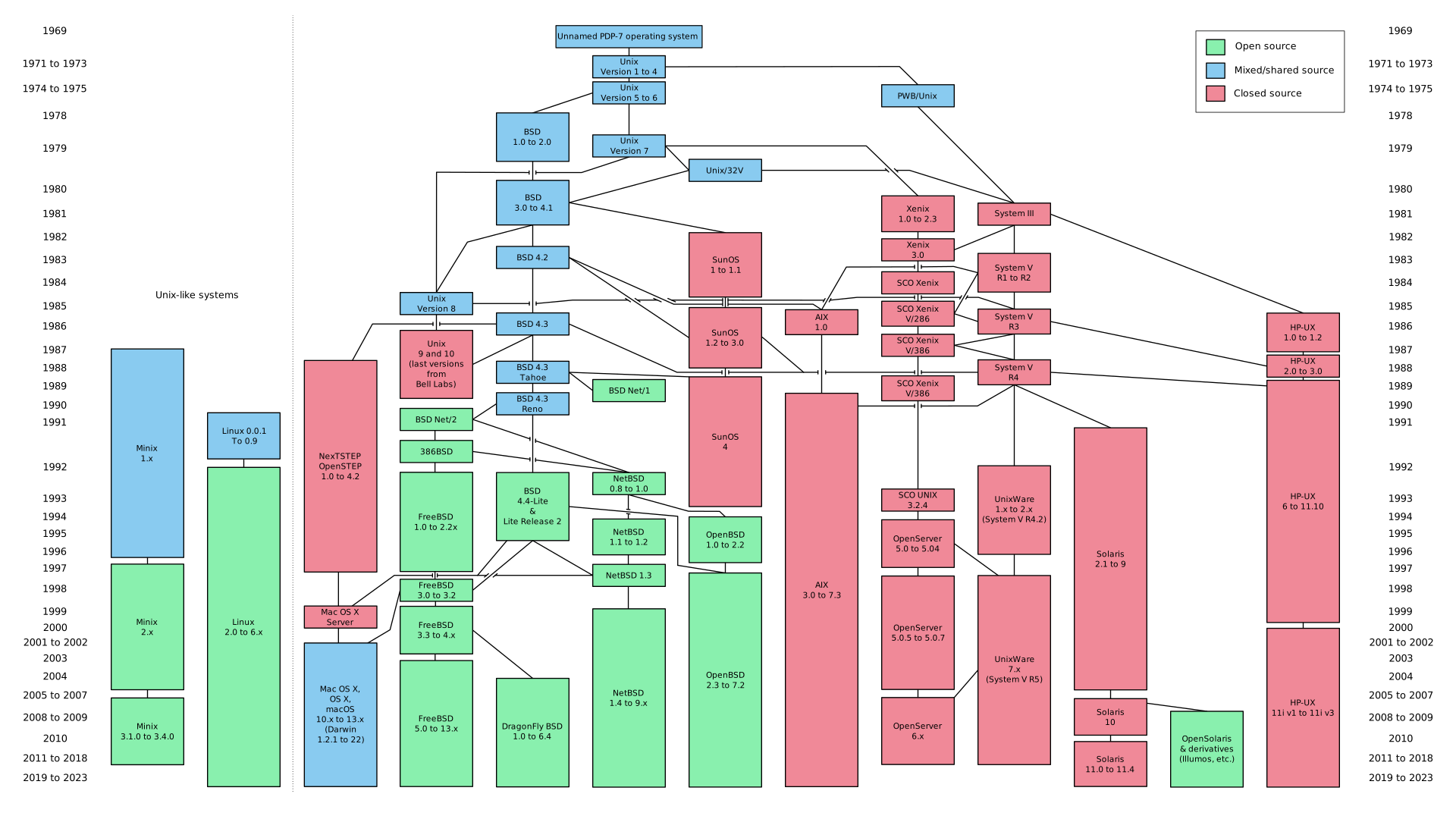
Open source software notoriously tends to require more integration than proprietary solutions.  The latter tend to be more complete, packaged offerings that are less prone to the code base fragmentation --with forking in development tracks-- that have afflicted the software industry since UNIX in the 1980s as illustrated in Exhibit 2.   Similarly, ongoing software maintenance tends to be more labour intensive for open source software users and their systems integrators.

Exhibit 2 Relationships among and evolution of UNIX-like operating systems Source: Wikipedia on “Unix-like”

There have been few thorough assessments on purported cost savings and other benefits with open source procurement policies by governments. Written here mostly verbatim as reported by the Guardian newspaper , an exception is the Dutch Audit Court which investigated "whether the phasing out of closed standards and the introduction of open source software would improve the operation of market forces and save costs for the government". Its March 2011 report entitled Open Standards and Open Source Software in Government "concluded amongst other things that the potential savings the government could [realise] by making more use of open source software were limited", and that the "switch to open source software...does not necessarily... lead to cost savings" at all. 
The Audit Court reasoned that, although there are no licensing or acquisition fees generally associated with open source software, there are other significant and accumulative fees. These include those relating to software implementation, management updates and maintenance. Moreover, in some other instances the switch to open source may even lead to "destruction of capital because the kingdom has many current licence agreements". No wonder this newspaper article was also very critical of the UK’s lurch toward open source software requirements for public procurement. 
Dutch analyst Victor De Pous has also analysed open source procurement in the context of government ICT procurement in the Netherlands. Among other conclusions, he states that “deciding which application to deploy solely based on cost savings or solely based on one preferred business model, is a too restrictive approach and will lead most likely to ineffective decisions with wide and long-time consequences.” It is rarely all or nothing with open source 
Open source software is rarely just that alone. For example, in smartphones, Android has drifted away from its Linux base and licensees have adapted it with proprietary layers (including Samsung’s Pure Breeze, Motorola’s Motoblur, HTC’s Sense) in their attempts to differentiate themselves. In government and enterprise ICT the additional programming is lucrative custom work for service businesses such as IBM, HP, Accenture, CSC, Redhat and many others. However, this can make it rather more costly to customers than with the update and support fees on packaged software.  This major conclusion was also drawn in a book entitled the Comingled Code. Its key findings are that both types of software are complementary and that total cost of ownership is not primarily software purchase cost.  It bases its findings on extensive research including more than 2,300 companies and nearly 2,000 programmers, spread across 15 countries. 
Damning reviews of UK government ICT projects clearly indicate escalating and excessive costs in customising and supporting systems. Those charges are predominantly derived from man hours of consultancy and custom programming, not from royalties on software products. The bugbears seem to be civil servants’ failings in negotiating and managing contracts, and runaway costs with the coterie of large systems integrators. 
Open source may not be entirely royalty free         
Open source licensing conditions can and often do bind software contributors and licensee users to royalty free conditions, but they cannot legally bind third parties outside of these agreements. If hardware or software implementations infringe the patent rights of others, then the latter are legally entitled to assert their patent rights. If the patent owners are members of a standards organisation and those rights are standards-essential, these owners will typically agree to license on a FRAND basis.  There is generally no conflict between open source licensing and paying patent royalties to third parties. The most stringent open source licenses; such as GNU GPLv3—in which “patents cannot be used to render the program non-free”—is seldom used because of such conflicts. In cases where licensing prohibits patent fees, the only legal solution is for such software to be written to ensure it does not infringe any IP that has not also been specifically declared royalty free by its owner. 
Standards-based patent royalties tend to be a relatively small proportion of total costs in ICT products, systems and services. For example, the aggregate royalties for patented radio technologies in mobile phones account for around 10%. The audio and video coder-decoder IP licensing costs around $4 per unit shipped. These fees are crucial to companies with upsteam licensing business models and can help defray R&D costs for vertically integrated companies. Other companies pay licensing fees in compensation for the innovative efforts of others. 
Head in the clouds thinking on royalty free with service-based usage and charging 
Where public cloud computing is employed, as discussed in the Forrester Research report referred to above, the issue of software licensing models becomes opaque to enterprise and government customers.  The question of open source and royalty free versus proprietary solutions in interoperability standards becomes much less relevant, if at all, when, by definition, public cloud computing substitutes remotely hosted services for hardware and software on the customer premises. When that occurs, every charge including that for use of underlying hardware and software, as well communications and technical support also become a service charge—just like software licensing fees, including up-front charges and running royalties. 
Under these circumstances, the pertinent cost question is how much will governments save by moving their on-premises applications and processing loads (e.g., email and office productivity) to the cloud? Savings can be substantial from a variety of vendors including Google, Microsoft and Amazon. These are achieved through economies of scale that the cloud providers can offer and are nothing specifically to do with open source or open standards. Customers are oblivious to how, where and how much cloud-based services providers pay to build their infrastructure and this should not be their concern so long as the cloud services provide the technical capabilities, reliability, flexibility and costs that are most competitive – which they do. 
Backpedalling 
Royalty-free software proponents are simply trying to re-open an argument that was already settled.  These issues were debated ad nauseam in with the definition of the term “openness” in the European Interoperability Framework version 2.0, which was finalized in December 2010.  The Commission ultimately settled on a definition that embraced FRAND, with or without a royalty, as the right benchmark.  This was in contrast to the EIFv1.0 which included a royalty free requirement.  EIFv1 was just a recommendation by an expert group deep in the Commission. It had no official status; which explains why it was able to take such an extreme and untenable position. In contrast, EIFv2 is an official communication by the Commission. That makes it a binding policy document, rather than something that member states and the EC itself can ignore. 
Impeding competition and choice 
Suppliers and their customers in government and elsewhere should have freedom in software selection including open source, proprietary, premises-based and cloud-based usage. This includes implementations that need to be significantly standards-compliant for interoperability and for any other reasons.Mandating royalty free software in government procurement on the false premise that this is necessary to ensure interoperability or minimise costs is a red herring that will harm competition and choice. Current arrangements allowing FRAND or royalty free licensing for standards-based ICT have served us well in many spheres. Mandating royalty free would severely limit procurement options because countless popular ICT standards are not royalty free. Open source software implementations are in many cases subject to patent royalties for use of essential and other patented IP and such software is commonly comingled with proprietary code. Academic research and an extensive audit in the Netherlands shows that open source software does not necessarily save money and can cost more. 
Even more troubling, is that rather than “levelling the playing field” for open source software developers, mandating royalty free open source software would actually be prejudicial to large and small vendors who would like to protect the IP they have developed and pursue licensing-based business models to generate royalties and cross-license for access to others’ IP. Public procurement policy should not also be the instrument to manipulate industrial policy for innovation, development and making money in the software industry. The adverse unintended consequences of such policies would be severe.