Ana Santos Rutschman at Saint Louis University Law School has authored an interesting short article titled, "Why Moderna Won't Share Rights to the COVID-19 Vaccine with the Government that Paid for Its Development" in The Conversation. The article basically outlines the U.S. government's technical and monetary contributions to the development of the mRNA technology and a dispute between Moderna and the U.S. government. The article is available, here. Moderna's stock has been falling overall, and I imagine this will not help as this is resolved. I've been worried about vaccine availability for some time, but I didn't realize so many would choose not to be vaccinated. It appears COVID-19 mutation will continue relatively unabated.
Saturday, 20 November 2021


Friday, 12 November 2021
The TRIPS Trap Revisited
By Roya Ghafele, OxFirst
The World Trade Organization’s Trade-Related Aspects of Intellectual
Property Rights (TRIPS) Agreement forced much of the
developing world to adopt minimal standards for intellectual property (IP) protection.
The imposition of such standards has been subject to much criticism. NGOs and
advocates of international development have raised serious concerns about TRIPS,
TRIPS Plus (which expands existing obligations under TRIPS), and the increasing
use of bilateral trade agreements to expand IP protection.
Critics of such agreements cite the costs associated with
enacting IP legislation and that, due to global IP protection, imitation as a
development strategy has been ruled out. These concerns can neither be denied,
nor is it the aim of this article to dismantle them. They are certainly important problems that
deserve to be further studied.
However, preliminary insights in the patent positions in
technologies relating to tobacco harm reduction suggests that out of 74 000
patents published on technologies aiming to reduce the harm of smoking, hardly
any cover the developing world.
With the exception of South Africa, the typical African
country has not seen any significant patent filings in this technology.
Figure 1: Indications of patents relating to vaping over
the last decade
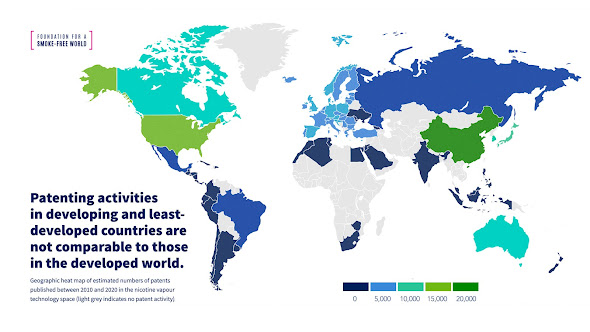
There may certainly be conditions lying outside of the patent system that have discouraged tobacco companies from creating IP in these countries. However, the significant difficulties developing countries may have faced with implementing the patent system, may also have discouraged patenting activities in the developing countries.
Many developing countries have struggled setting up
functioning patent offices, finding qualified staff, training judges in IP and
developing local IP professionals. in some countries patent offices may have
been established without the necessary infrastructure or human capacity to
successfully examine patent applications. IP legislation has been enacted
without investing in the necessary infrastructure to turn legal theory into
legal practice. None of this may have been undertaken in bad faith or to
wilfully breach a commitment to international trade.
Rather, the sad reality is that in many developing
countries there is very little understanding about IP and its economic impact. Even
at the European level, the qualifying exam for European patent attorneys is
more successfully passed by Brits or Germans, rather than their colleagues from
less-privileged countries. Greece, for example, has up until now not succeeded
in developing patent attorneys and the job is undertaken by lawyers.
Lack of know-how and know-why, are probably the primary
reasons many developing countries are still grappling with the IP system. Leading
IP economies have often been less than understanding about the constraints
facing developing nations. The Office of the US Trade Representative for
example releases annually a special report on IP and review of notorious
markets for counterfeiting and piracy.
International development aid for IP has been rather scattered.
The World Intellectual Property Organization (WIPO) followed the United States
Agency for International Development (USAID) offer the most important support
for IP-related development assistance. However, at the international level technical
assistance can often be neither coordinated nor continuous. With the exception
of WIPO, such assistance may also have a tendency to reflect the specific
requirements of the bilateral donor country, rather than focus on the larger
needs of a developing country or an entire region.
All of this has led to the current sorry state of global IP
law. While some nations are at the forefront of defining the technology law of
the future, others are still confronted with a situation where ordinary people
have probably not even heard of intellectual property.
The initial analysis in the tobacco space was a harsh
awakening as to how at least one sector of the economy assesses the value
proposition of developing countries’ IP systems. Tobacco companies are waging
trans-jurisdictional patent battles over next-generation tobacco products, but
at the same time their focus on developing country IP is minimal.
This is at odds with the market reality. Over 85% of
smokers live in developing countries, yet the patent focus remains on developed
nations. The market potential for tobacco harm-reducing products in developing
nations is substantial, if these products were to be made available globally,
rather than to consumers in developed countries only. This would not only
expand business opportunities for the tobacco industry, but would also offer people
around the globe less harmful ways to consume tobacco. A potential “win-win”
situation is being hampered by a deplorable implementation of the patent system
in many countries.
I do not want to be misunderstood as a hard-core advocate
of the patent system. However, the initial patent landscape analysis made me
wonder if in the 21st century any nation can truly afford to stay outside of
that system. The reality is that, doing so, translates into marginalization. This
segregation may be so pronounced that companies may not be motivated to invest
in patents in these countries. Usually, this also means that they have no
intention of selling patented products in these countries, leading to restricted
consumer choice and limited take-off of technology. Whether this is indeed a
better development choice should be a subject of further discussion.
Key words: smoking, tobacco hard reduction, patent protection, low- and middle-income countries
Disclosure of Conflict of Interest: OxFirst has been compensated by the Foundation for a Smoke-Free World, the views are
the author’s own. The preliminary patent landscape report is available here and here.
Saturday, 6 November 2021
U.S. DOJ Settles Generic Drug Price Fixing Cases -- Over $400 million
The U.S. Department of Justice has settled several lawsuits concerning essentially of illegal price fixing between companies offering generic drugs. This is a continuation of the problems facing drug pricing and the generic market. Government production of generics may be the future. The U.S. Department of Justice press release states, in part:
Three generic pharmaceutical manufacturers, Taro
Pharmaceuticals USA, Inc., Sandoz Inc. and Apotex Corporation, have agreed to
pay a total of $447.2 million to resolve alleged violations of the False Claims
Act arising from conspiracies to fix the price of various generic drugs. These
conspiracies allegedly resulted in higher drug prices for federal health care
programs and beneficiaries according to the Justice Department.
The government alleges that between 2013 and 2015, all three
companies paid and received compensation prohibited by the Anti-Kickback
Statute through arrangements on price, supply and allocation of customers with
other pharmaceutical manufacturers for certain generic drugs manufactured by
the companies.
Taro Pharmaceuticals USA, Inc., headquartered in New York,
has agreed to pay $213.2 million. The Taro drugs allegedly implicated in this
scheme address a wide variety of health conditions, and include etodolac, a
nonsteroidal anti-inflammatory drug used to treat pain and arthritis, and
nystatin-triamcinolone cream and ointment, a combination of an antifungal
medicine and steroid used to treat certain kinds of skin infections.
Sandoz Inc., headquartered in New Jersey, has agreed to pay
$185 million. The Sandoz drugs at issue include benazepril HCTZ, used to treat
hypertension, and clobetasol, a corticosteroid used to treat skin conditions.
Apotex Corporation, headquartered in Florida, has agreed to
pay $49 million in connection with its sale of pravastatin, a drug used to
treat high cholesterol and triglyceride levels.
“Illegal collaboration on the price or supply of drugs
increases costs both to federal health care programs and beneficiaries,” said
Acting Assistant Attorney General Brian M. Boynton of the Justice Department’s
Civil Division. “The department will use every tool at its disposal to prevent
such conduct and to protect these taxpayer-funded programs.”
“These civil settlements are another achievement in my
office’s efforts to hold generic drug companies accountable for the consequences
arising from price-fixing schemes, including the harm to federal health care
programs,” said Acting U.S. Attorney Jennifer Arbittier Williams for the
Eastern District of Pennsylvania. “We will continue to aggressively pursue
these violations of the Anti-Kickback Statute and the False Claims Act and
obtain significant recoveries.”
“Conspiring to raise prices on generic medications is illegal
and could prevent patients from being able to afford their needed prescription
drugs. Americans have the right to purchase generic drugs set by fair and open
competition, not collusion,” said Special Agent in Charge Maureen R. Dixon of
the Philadelphia Regional Office of the Inspector General, Department of Health
and Human Services (HHS-OIG). “HHS-OIG along with our law enforcement partners
will continue to investigate allegations of companies engaging in actions that
put the public and the Medicare program at risk.”
In connection with its settlement agreement, each company
also entered a five-year corporate integrity agreement (CIA) with OIG. The CIAs
include unique internal monitoring and price transparency provisions. They also
require the companies to implement compliance measures including risk
assessment programs, executive recoupment provisions and compliance-related
certifications from company executives and board members. . . .
The Anti-Kickback Statute prohibits companies from receiving
or making payments in return for arranging the sale or purchase of items such
as drugs for which payment may be made by a federal health care program. These
provisions are designed to ensure that the supply and price of health care
items are not compromised by improper financial incentives. These settlements
reflect the important role of the False Claims Act to ensure that the United
States is fully compensated when it is the victim of kickbacks paid to further
anticompetitive conduct.
All three companies previously entered into deferred
prosecution agreements with the Antitrust Division to resolve related criminal
charges. Taro paid a criminal penalty of $205.6 million and admitted to
conspiring with two other generic drug companies to fix prices on certain
generic drugs. Sandoz paid a criminal penalty of $195 million and admitted to
conspiring with four other generic drug companies to fix prices on certain
generic drugs. Apotex paid a criminal penalty of $24.1 million and admitted to
conspiring to increase and maintain the price on pravastatin. The civil
settlement payments announced today are in addition to the criminal penalties
paid by the companies.
The press release is available,
here.
Thursday, 4 November 2021
Morrison and Foerster Sponsors Webinar titled, "In a Founders Market, Strategic Capital Thrives."
The law firm Morrison & Foerster (a very famous law firm based in California known as MoFo) is sponsoring a free webinar on the “buyer’s market” for capital titled, “In a Founders Market, Strategic Capital Thrives.” The webinar is scheduled for “Tuesday, November 16, 2021[,] 9:00 a.m. – 10.00 a.m. PT[,] . . . 5:00 p.m. – 6:00 p.m. GMT.”
Additional details are below:
|
2021
is turning out to be a record-setting year for investment in VC-funded
startups and private companies. This vast global liquidity has caught the
eyes of non-traditional investors including sovereign wealth funds and
limited partners, both of whom are looking to boost returns with direct investments. This makes it a
buyer’s market for startups, and the best entrepreneurs have access to what
seems like unlimited capital.
Panelists Include:
|
RSVP is available, here.
Wednesday, 3 November 2021
U.S. FDA Sends Letter to Push USPTO Concerning Drug Patents and Access
The U.S. Federal Food and Drug Administration (FDA) recently sent a letter to the U.S. Patent and Trademark Office concerning the FDA’s concerns regarding pharmaceutical patents and their impact on innovation and access. Some of the concerns include the use of continuations to build patent thickets to raise litigation costs as well as resulting in possible delays of generic entry; evergreening practices; and product-hopping. Notably, the FDA is generally interested in increasing communication and collaboration to address those issues, including offering expertise, collecting additional information regarding IPRs and other post-grant procedures as well as inquiring whether examiners need more time to review patent applications. While the Trump Administration also had concerns regarding drug pricing, President Biden’s recent Executive Order concerning competition is the impetus for this letter’s push for increased collaboration.
U.S. Federal Trade Commission Releases New Safeguards Rule for Non-Banking Financial Institutions
The Federal Trade Commission (FTC) in the United States has changed the regulations concerning the Safeguards Rule relating to cybersecurity standards for non-banking financial institutions. Essentially, the new Safeguards Rule contains additional specificity regarding what is required to comply with the contextual administrative, physical and technical standards for a compliant information security program. The new Safeguards Rule will be effective a year from publication in the Federal Register. Notably, the new Safeguards Rule contains significant new definitions. The FTC press release states, in relevant part:
The FTC’s updated Safeguards Rule requires non-banking
financial institutions, such as mortgage brokers, motor vehicle dealers, and
payday lenders, to develop, implement, and maintain a comprehensive security
system to keep their customers’ information safe.
“Financial institutions and other entities that collect
sensitive consumer data have a responsibility to protect it,” said Samuel
Levine, Director of the FTC’s Bureau of Consumer Protection. “The updates
adopted by the Commission to the Safeguards Rule detail common-sense steps that
these institutions must implement to protect consumer data from cyberattacks
and other threats.”
The changes adopted by the Commission to the Safeguards
Rule include more specific criteria for what safeguards financial
institutions must implement as part of their information security program such
as limiting who can access consumer data and using encryption to secure the
data. Under the updated Safeguards Rule, institutions must also explain their
information sharing practices, specifically the administrative, technical, and
physical safeguards the financial institutions use to access, collect,
distribute, process, protect, store, use, transmit, dispose of, or otherwise
handle customers’ secure information. In addition, financial institutions
will be required to designate a single qualified individual to oversee their
information security program and report periodically to an organization’s board
of directors, or a senior officer in charge of information security.
The Safeguards Rule was mandated by Congress under the 1999
Gramm-Leach-Bliley Act. Today’s updates are the result of years of public
input. In 2019, the FTC sought
comment on proposed changes to the Safeguards Rule and, in 2020
held a
public workshop on the Safeguards Rule.
In addition to the updates, the FTC is seeking comment on
whether to make an additional change to the Safeguards Rule to require
financial institutions to report certain data breaches and other security
events to the Commission. The FTC is issuing a supplemental notice of proposed rulemaking,
which will be published in the Federal Register shortly. The public will have
60 days after the notice is published in the Federal Register to submit a
comment.
The new Safeguards Rule is available, here. Notably, there is legislation before the U.S. Congress to massively increase the budget of the FTC to deal, in part, with privacy and cybersecurity issues.
Thursday, 30 September 2021
Essentiality Rate Inflation and Random Variability in SEP Counts with Sampling and Essentiality Checking for Top-Down FRAND Royalty Rate Setting
Fair, reasonable and non-discriminatory (FRAND) royalty rates for licensing standard-essential patents (SEPs) are increasingly derived “top-down” by dividing a notional aggregate royalty percentage (e.g., 10% of a smartphone’s selling price for 4G LTE) among patent owners based on the proportions of patents they own that are deemed to be standard essential.[1] Other rate-setting methods include use of comparable licenses and measuring value derived from SEPs. However, as stated by Justice Birss in Unwired Planet: “In assessing a FRAND rate counting patents is inevitable.”[2] He used top-down methodology as a cross check. The FRAND rate Decision in TCL v. Ericsson, that was unanimously and entirely vacated on appeal, also relied on a top-down valuation.[3]
 |
| Ball colour, not patent essentiality, can be identified with 100% accuracy when sampling |
Essentiality checking is also proposed by the European Commission
and others to improve transparency for prospective licensees.[4] But transparency is only legitimate if what
is being revealed and counted is reasonably accurate and does not mislead.
Otherwise, it will likely do more harm than good.
If patent counting with essentiality checking is going to be used
in FRAND-rate determinations, then it is vital we understand its dynamics,
failings, how to properly interpret its results, and how to design and size
essentiality determination studies that are fit for purpose. This research
article contributes to that quest.
Figuring out which patents are true SEPs and then counting
them is fundamental to top-down analysis. With hundreds of thousands of patents
declared possibly standard essential,[5]
and the insuperably huge task in checking them all for essentiality, the
European Commission and others propose that assessing only samples of patents declared essential
to a standard would suffice.
Institutionalising use of patent counting—with or without sampling—is an under-researched and impetuous leap of faith. Different assessors come up with wildly different patent counts. Comparison of two separate assessors determining essentiality on the same sample of patents indicates that assessors tend to inflate true essentiality rates. These over-estimates result from statistical bias with numbers of false positives (i.e., truly not essential patents being found to be essential) exceeding false negatives when true essentiality rates are rather less than 50%.
I also conclude from my simulation modelling and analysis that:
1. The lower the true essentiality rate and the lower the rate of agreement among different assessors, the larger the differences will be between the essentiality rates determined by assessors and the true essentiality rate. For example:
a. If true essentiality rates are 30% and two different assessors agree with each other on 75% of their determinations, they will tend to estimate 36% essentiality rates and be accurate in 85% their determinations.
b. If true essentiality rates are only around 10% (e.g., for 4G LTE or 5G), as some experts plausibly argue, and if two assessors agree with each other on 84% of their determinations, they will tend to estimate 17% essentiality rates and be accurate in 91% of their determinations. That means there will be nearly as many false positives as correct determinations of essentiality.
2. Therefore, if true essentiality rates are at the lower end of expectations, for example, at around 10% or less, it is imperative assessors are highly accurate in their determinations, otherwise false positives will swamp their correct determinations and make their overall results meaningless.
Sampling reduces the precision of SEP counts with increased variability, which is exacerbated by erroneous essentiality determinations. Sampling theory and simple simulations using results of patent-counting studies already undertaken—including several with sample sizes below a few hundred—reveal unacceptably large ranges in expected essentiality rate determinations (i.e. the percentage of declared-essential patents that are deemed to be essential)[6] at what various study authors regard as the “well accepted bound” of the 95% confidence level.[7] This variability is particularly large where patent essentiality rates are at low levels, such as at around 10%. For example, 10% ± 1.5% is actually ± 15% variability as a proportion of that 10% figure. The quantitative analysis I undertook for this article measures the extent of diminutions, which should be properly and fully considered before sample sizes are set, and before the short cut of sampling is blindly adopted at all.
Top-down methodology seemingly enables precise assessments of
FRAND royalties, but this is an illusion due to various inconsistencies and
inaccuracies in patent selection, sampling and essentiality assessment. Key
questions are how much precision is adequate and how can that be obtained? The
optimal balance between extensive and costly patent-essentiality assessments, that
can take days of work per patent, versus reducing the number of assessments by
sampling should be decided with due regard to accuracy and confidence levels required,
and based on empirical assessments.
While there are no set bounds for the acceptably accurate
range in determinations, I have considered a reasonable proportionate accuracy requirement
for essentiality rate determination to be <± 15% (i.e., a 30% range for the determined
essentiality rate as a proportion of the true essentiality rate) at the 95%
confidence interval level. With my opinion that true essentiality rates are
more like 10% than 30% or 40%, I conclude from my analysis that samples including thousands of patents are
required in top-down FRAND-royalty rate setting. For example, if the
essentiality rate is only 10%, a sample size approaching 3,000 declared-essential
patents per standard, at the very least, would be required.
My full article, including detailed statistical analysis, can be downloaded here.
[1]
These percentages in mobile phone licensing are typically applied to the
wholesale selling prices of finished goods products.
[2] Approved Judgment in Unwired Planet versus
Huawei, 5th April 2017 at 806 (11). https://www.judiciary.uk/wp-content/uploads/2017/04/unwired-planet-v-huawei-20170405.pdf
[3] http://www.ip.finance/2018/04/unreasonably-low-royalties-in-top-down.html
and https://www.reuters.com/legal/transactional/ericsson-tcl-settle-long-running-smartphone-patent-disputes-2021-07-19/
[4] https://ec.europa.eu/growth/content/transparency-sep-licensing-how-clarify-possible-exposure-upfront_en
[5] Declaring
one’s patents that are possibly standard essential is a requirement for
participation in organisations such as 3GPP in the setting of standards such as
4G LTE and 5G.
[6] This is
also called the essentiality ratio.
Tuesday, 7 September 2021
Modest SEP royalties on smartphones have declined and licensing is stabilizing
Aggregate royalty payments for licensing cellular technology standard-essential patents (SEPs) in smartphones have remained in modest single-digit percentages and have declined since 2013.
This defies
purported concerns that the stacking of patent royalties paid to multiple
licensors has led to or would lead to unreasonably high aggregate rates on
mobile devices. It also counters the claims of some original equipment manufacturers (OEMs) and others that
various SEP owners demand licensing fees in excess of what is fair, reasonable
and non-discriminatory (FRAND).
The true aggregate price is fair and reasonable
Amid wild
speculation about SEP licensing charges up until 2015, one article drawing a
lot of attention around then outrageously asserted the cost could be 30 percent
of a $400 smartphone price. In response, I set about measuring how much in
patent royalties was actually being paid in comparison to total revenues generated
on mobile handset sales (e.g. $410 billion in 2014, according to IDC). I termed
the ratio of the two figures, expressed as a percentage, the “royalty yield.”
This is an average reflecting all royalties paid divided by the total of licensed
and unlicensed handset sales revenues. I found the royalty yield to be no
more than around 5 percent in aggregate including all licensors. That percentage is
the sum of the royalty yields for individual licensors.
My
assessments were conservatively high because some of the royalties paid are for
licensing intellectual property other than cellular SEPs, or are for network
equipment, devices such as PC data sticks or IoT appliances.
I found
that major licensors Alcatel-Lucent, Ericsson, InterDigital, Nokia and Qualcomm
accounted for most royalties paid, even with conservatively high estimates for
other licensors. For example, I included 3G and 4G LTE patent pool licensing at
rate card prices, even though it was evident hardly any implementers were
signing up for those.
My
methodology and results were replicated and validated in a couple of academic research papers, including
one enduring peer review before publication, which with more detailed analysis showed aggregate
yields to be even lower than my estimates.
Aggregate royalties declined despite global boom in 4G LTE smartphones and introduction of 5G
Total royalties and royalty yields have fallen substantially since 2015 for those major cellular SEP licensors. While 4G LTE smartphone sales surged, OEMs have managed to reduce royalty rates paid for licensing. For example, even though royalties are generally charged as a percentage of a phone’s selling price, royalty caps limiting the royalty charge—as if the phone price was, for example, $200 or $400—ensure that royalty yields reduce as smartphone prices are raised, for example, with introduction of new models priced at $1,000 or more in recent years.
Licensing
revenues and aggregate royal yield for major mobile SEP licensors
2013-2020

Source: Company financial disclosures and
WiseHarbor analysis.
Nokia completed its acquisition of Alcatel-Lucent in 2014.
Qualcomm figures include retroactive allocations of licensing dispute settlement
payments of $4.7 billion by Apple in 2019 and $1.8 billion by Huawei in 2020
that were not included in Qualcomm Technology Licensing segment figures.
With the
introduction of each new generation of mobile technology since 3G, it was also
alleged that charges for the new standards would stack further to an
unreasonable aggregate burden on OEMs and consumers. However, despite 5G’s
commercial introduction in 2019, aggregate royalties have not risen for these
companies that also first announced programs and charges for 5G licensing.
Up and downs
There is
was substantial increase in royalty income for Nokia from 2014. But this is
unsurprising due to a dramatic change in the company’s industry profile and
business model following the divestiture of its smartphone business to
Microsoft that year. For Nokia prior to 2014, as for Samsung and Apple since
then, SEP licensing was more oriented to minimizing—through cross-licensing—the
licensing fees charged by other patent owners on market-leading handset sales,
than to generating cash royalties. A question posed to me by a hedge fund
client back then was: ‘to what extent and how quickly could Nokia “unroll” its
cross-licenses to increase the cash royalties it receives?’ Nokia’s licensing
revenues more than doubled between 2014 and 2017 before declining around 15 percent
in the following years to 2020. The company’s royalty yield also doubled to 0.4
percent before falling back somewhat over the same time periods.
Though
royalty fees for Ericsson, Nokia and Qualcomm are modest in comparison to
revenues from all their other sales, royalties are very important because profit
margins on licensing are relatively high. SEP licensing fee income is crucial
to fund the substantial ongoing R&D investments by all these licensor
companies, also including InterDigital. With development of further
standard-essential technologies, the benefits of those investments also become openly
available to the entire mobile ecosystem.
The major
licensors detailed in my 2015 analysis received more than half of all royalties
paid and still do despite the overall decline in licensing revenues for these
companies. The aggregate royalty yield including the above-named companies and
all other licensors has also declined. As other players have become more
significant in licensing, these have had only minor effects on aggregate royalties
paid by OEMs to all licensors. For example, while Huawei now boasts large
shares of patents declared essential to LTE and 5G standards, with its
smartphone market share second only to Samsung in 2019, like old Nokia, Samsung
and Apple, Huawei has also been more focused on minimizing the royalties it has
had to pay out than on increasing the cash royalties it generates. With
cross-licensing, OEMs with SEP portfolios share their intellectual property
while minimizing licensing costs on their product manufactures and sales.
With the US chip supply bans on Huawei and with it
spinning off its Honor sub-brand, Huawei’s smartphone market share has plummeted and it is also now seeking
to increase its patent monetization. While Huawei has reportedly paid out
more than $6 billlion in patent fees over decades, it is expecting to generate
between $1.2 billion and $1.3 billion in patent licensing revenues between 2019
and 2021. I presume
that means revenues averaging around $420 million per year over three years.
Similarly, with LG exiting the smartphone market due to its poor profitability there,
despite its large mobile SEP portfolio, it could also seek to increasingly
monetize its SEPs through licensing, or through patent sales.
There are
other cellular SEP licensors, including some so-called patent assertion
entities that have obtained headline-grabbing licensing awards. But the
significance of these on aggregate royalty yields is also relatively small. Large
award figures tend to cover numerous years of infringement and it can take many
years of litigation with awards being amended or revoked before appeals
processes are exhausted or settlement with lower amounts paid. Following the annulment
of a $506 million jury verdict last year in favor of PanOptis for 4G LTE patent
infringements by Apple, a recent jury retrial including directions to consider requirements
for FRAND licensing terms has revised the award to $300 million. Apple says It
plans to appeal.
It is OEM conduct that unlevels the playing field
Contentions
about royalty charges are as much about the differences in licensing fees among
licensees as they are about the level of charges overall. It is these
differences that effect competition among OEMs.
The absolute
costs of patent licensing fees have never had much effect on overall market demand
because aggregate royalties paid by OEMs are modest in comparison to their handset
prices and revenues. While many OEMs,
including larger ones like LG in recent years, struggle for profitability, it
is the disparities in the amounts paid—or not paid—for licensing that can cause
significant competitive disadvantage or advantage among smartphone and other
device OEMs. For example, all manufacturers have to pay somewhat similar prices
for commodities such as batteries and memory chips, and European value added
taxes are levied at exactly the same rate on all manufacturers’ devices sold,
at national rates ranging from 17 percent to 27 percent.
While the
onus is upon licensees to be non-discriminatory in their licensing charges, it
is OEMs implementing SEP technologies that push for the inequalities. All the
major licensors publish rate cards and would willingly license to all OEMs at
those prices. However, major licensees such as Apple are formidable counterparties
in licensing negotiations and disputes. They have the motivation, deep pockets
and clout to force burdensome and drawn-out litigation, and yet can offer
enticements such as substantial cash lump sums up-front for settlement at low
effective royalty rates. Other OEMs have found it advantageous to hold out from
making any royalty payments for years under the rationale that litigation is
cheaper, even if it only delays eventual payment of FRAND royalties.
While for
many years the debate on FRAND was largely about what might be a fair and
reasonable rate for individual licensors in general, and for all of them in
aggregate, SEP litigation is increasing about discriminatory pricing. Unacceptable
versus acceptable discrimination (i.e. differences in royalty pricing for
different licensees) apparently hinges on whether different licensees are deemed
“similarly situated.” It was a key question in selecting “comparable licenses”
in TCL v. Ericsson, as it is in other disputes. This is still work-in-progress
in the courts.
Expanding the royalty base with licensed sales in IoT
My royalty
yield figures are conservative because they are based on the denominator of
mobile phone sales revenues which does not includes any sales revenues from
other cellular-enabled products including tablets, PC data sticks and IoT
devices. The inclusion of any such revenues would reduce royalty yields
further. With IoT becoming more significant in mobile communications in recent
years, omitting the increasing revenues for those devices from the denominator
of my royalty yield calculations makes my yield curve the above graphic an
increasingly conservative depiction of how low royalty charges are.
Measuring
and assessing whether royalty charges are FRAND or burdensome overall is more
complex beyond phones where the royalty yield was a simple and useful metric. Other
devices range from simple sensors to refrigerators, cars and industrial
equipment. The prices for these and the value they derive from cellular
connectivity varies enormously.
Non-phone
devices are commonly licensed, but sales of these and licensing revenues on
them have been relatively small. Mobile phones continue to dominate numbers of
cellular devices sold and licensed, but the proportion of non-cellular devices
has gradually increased. According to GSMA Intelligence, the percentage total cellular
network connections that are “machine-to-machine” increased from 2.7 percent of
6.9 billion worldwide in 2013 to 17.4 percent of 10 billion in 2020. The percentages of non-phone device sales,
upon which royalties are due, would be higher in these growing markets because
it is the accumulated sales of devices over several years that drive the total
numbers of connections.
With the anticipated growth in IoT including 5G and applications such as connected cars, some analysts, including JP Morgan in a June 2021 equity research report, project significant non-smartphone revenues: for example; “an estimated ~$1 bn of the ~$6.5 bn of QTL revenue being derived from non-handset license royalties.”
Qualcomm Technology Licensing revenue breakdown

Increased SEP pooling makes sense, but buyers cartels are anticompetitive
I have already written
here that the voluntary option of one-stop-shopping for patent licenses in IoT makes sense to minimize the transaction costs in
licensing with dozens of patent owners and thousands of licensees with a wide
variety of applications.
However, initiatives
to form buyers’ groups (aka Licensing Negotiation Groups) that would
“negotiate” royalty rates from licensors collectively and, in effect, exclusively
on behalf of IoT implementers would harm the increasing stability achieved in
FRAND licensing. These monopsony cartels would have dire anticompetitive effects.
As noted by a couple of commentators: “while implementers should be consulted about the
reasonableness of standard’s technology aggregate price, the final pricing
decision should better be left to SEP owners…. Permitting companies that have not developed and do not own
technology to decide on its price would effectively resemble an expropriation
of technology, making SEP owners rightfully sceptical about participating in
such joint negotiations.”
Even patent pools like
MPEG LA’s for H.264 video SEPs—with participation from some major patent owners
who are also major OEM licensees—tend to depress royalty rates significantly below
what would be and is charged bilaterally. All well and good, maybe, for voluntary
participants (as the law requires) with mixed business models including patent
fee generation and standards-based product supply, but totally unacceptable compulsorily
for licensors, or as the only way licensees would be obliged to agree to
anything. In the case of Bluetooth and DOCSIS licensing, pool rates have been
driven down to royalty-free levels, which means that the product markets are
the only way to make money from patented technologies in those standards.
All suppliers need sanctions against non-payers
In product
and service trading, if a customer does not pay for what it receives, its
suppliers will soon stop supplying. Not so with patented technologies. The
published standards documents, patent filings and SEP declarations reveal
technologies and their application openly to all. The only way a patent holder
can withhold supply of its intellectual property is through an injunction. But
these are notoriously longwinded and difficult to obtain—if they can ever be
obtained at all— particularly for patents that have been declared standard essential
by their owners. Europe has the well-established Huawei v. ZTE framework for determining under what
conditions and developments injunctions can be applied for and then issued. The
direction of US public policy on this matter is unclear with President Biden’s executive order asking the Justice and Commerce
Departments to reconsider the previous administration’s position that patent
holders have the right to seek injunctions against potential SEP licensees.
Fair and calmer conditions ahead
For now,
the outlook in FRAND licensing appears relatively peaceful. In addition to the
numerous agreements that are negotiated and licensed without dispute, recent
FRAND licensing settlements following litigation between Ericsson and Samsung, InterDigital and Xiaomi and Ericsson and TCL, signal increasing calm in
smartphone licensing. For example, with the US District Court’s FRAND-licensing
determinations for 2G, 3G and 4G LTE in TCL v. Ericsson unanimously and entirely
vacated on appeal, the parties have subsequently settled confidentially rather
than go to retrial with a jury.
A licensing
agreement at the car OEM level —following years of litigation between Nokia and Daimler and an EU antitrust complaint about
where in the supply chain SEPs should be licensed—is a major breakthrough in
the way cars and their components are licensed. This bodes well for dealing
with the complexities elsewhere in IoT
licensing, with
numerous different applications, devices and component manufacturers and OEMs. However,
this is still only the very beginning of that saga.
This article was originally published in RCR Wireless on 3rd September 2021.
Tuesday, 3 August 2021
Who Benefits from the Fruit of Research from Human Cells? Civil Rights Attorney Representing Henrietta Lacks Family
In a fascinating turn of events, Ben Crump, the prominent civil rights attorney who represented the family of Treyvon Martin and Breonna Taylor, is representing the family of Henrietta Lacks, a deceased African-American woman. Ms. Lacks’ cells were used without her consent to develop a cell line at Johns Hopkins Hospital (extracted from her in 1951). There is a book and movie concerning her story. According to Johns Hopkins Medicine’s website honoring Ms. Lacks:
Today, these incredible cells— nicknamed "HeLa"
cells, from the first two letters of her first and last names — are used to
study the effects of toxins, drugs, hormones and viruses on the growth of
cancer cells without experimenting on humans. They have been used to test the
effects of radiation and poisons, to study the human genome, to learn more
about how viruses work, and played a crucial role in the development of the
polio vaccine.
. . . Over the past several decades, this cell line has contributed to many medical breakthroughs, from research on the effects of zero gravity in outer space and the development of the polio vaccine, to the study of leukemia, the AIDS virus and cancer worldwide.
The website also states:
In 2013, Johns Hopkins worked with members of the family and
the National Institutes of Health (NIH) to help broker an agreement that
requires scientists to receive permission to use Henrietta Lacks’ genetic
blueprint, or to use HeLa cells in NIH funded research.
The committee tasked with deciding who can use HeLa cells now
includes two members of the Lacks family. The medical research community has
also made significant strides in improving research practices, in part thanks
to the lessons learned from Henrietta Lacks’ story.
Moreover, the legal area and practices have developed since
1951, including the development of informed consent laws. The website also notes that John Hopkins was
one of the few hospitals that accepted poor African Americans as patients in 1951.
The likely defendants will include pharmaceutical and biotechnology companies
as well as John Hopkins. This case—assuming
it survives many legal challenges and is not settled relatively early (those are big “ifs”)—could
result in some very interesting law on the merits that may be challenging to
the biotechnology and pharmaceutical industries.
In 1990, the California Supreme Court basically decided in Moore v. Regents of the University of California that a patient did not retain a
property interest in tissue extracted from him.
Notably, his cells were also used to develop a cell line. The majority’s decision was influenced by
prudential concerns, including expressed fear about impeding the development of
the promising biotechnology industry. Importantly,
the case was decided when the biotechnology industry was arguably quite young
and the reasoning in that case was based on some factors that may not hold true
today—due to changes in the law, the development of technology, and changing
expectations and practices. Other courts
in the United States, in deciding similar issues, have basically stated that equity (unjust enrichment) may provide hope for some compensation to the party whose cells have
been utilized by researchers. A rejection
of Moore would have interesting implications for the field and the
preservation and protection of human dignity.
The timing of the filing of the lawsuits is interesting
because my guess is that public opinion of the pharmaceutical/biotechnology industry
is relatively high in the United States given the development of the vaccines for COVID-19. However, the continuing disaster of the
failure to get enough vaccines to the Global South and other parts of the world will result in additional human death and suffering, including the proliferation of variants which may evade
vaccines. This could turn the tide of
public opinion in the United States—along with high pharmaceutical prices—and result in additional pressure
to settle.
Subscribe to:
Posts (Atom)